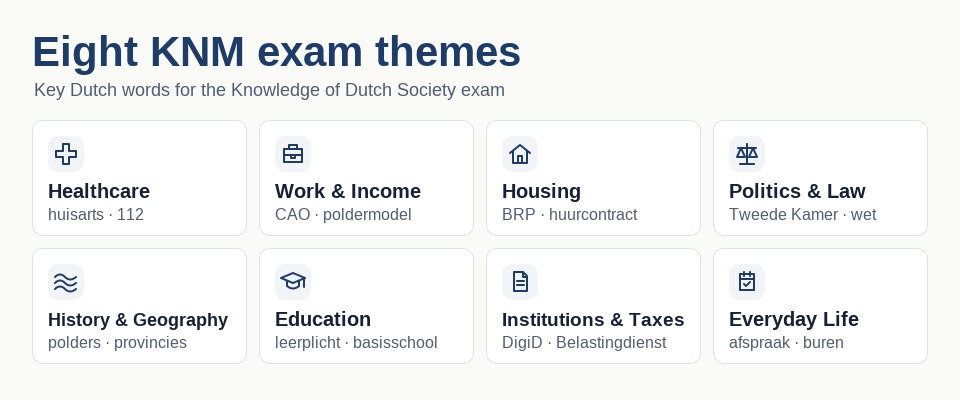
A KNM practice test helps you connect Dutch words with decisions you might make in daily life. Our two original sets cover Kennis van de Nederlandse Maatschappij: one has 40 questions and the other has 35 different questions. Use them for knm oefenen in study mode or choose a timed session, then review why each answer fits.
KNM practice test format and official exam
The official KNM exam is a computer-based assessment about Dutch society. DUO says it lasts 45 minutes and contains questions on several themes. Our full first mock uses 40 questions in that time; the number in our practice bank is an editorial choice, not a claim about the current official question count. The second set offers 35 new situations. Check DUO’s current knowledge exam information and its free sample exams.
The score target displayed here is a study aid set by this site. It is not an official DUO passing score and cannot predict your result. The point of a KNM practice test is to find the areas where you need clearer understanding, not to memorise our answers as official exam questions.
Eight themes in the KNM practice test
Our eight labels organise a broad civic syllabus into manageable groups. They are study categories, not a promise that DUO uses identical category names or distributes official questions in the same proportions.
Healthcare: start with the right service
For ordinary non-emergency complaints during practice hours, call the huisarts, your GP. If urgent GP care cannot wait until the practice opens, contact the huisartsenpost. Call 112 for an immediate life-threatening emergency. A GP usually decides whether to refer you to a specialist with a verwijsbrief. A prescription is normally collected at an apotheek; a drogist also sells simple medicines without prescription.
Adults subject to Dutch insurance requirements need basic health insurance. Children under 18 do not pay a basic insurance premium or mandatory deductible. GP care is generally outside the mandatory deductible, while separate investigations may not be. Maternity care is also exempt from that deductible, although a separate contribution can apply.
Work and income: know who helps
A CAO can add to legal employment conditions. Notify your employer promptly when ill; a bedrijfsarts, not your GP, advises about ability to work. Employers generally continue wages for up to two years, subject to legal rules. UWV handles applications for unemployment benefit (WW) and assesses disability benefits such as WIA. For last-resort social assistance, ask the municipality about bijstand and eligibility.
Housing: understand the contract
A woningcorporatie lets social housing under allocation rules, often with waiting lists. Keep your rental agreement and report repairs to the landlord. For an eligible regulated-rent dispute, the Huurcommissie may be able to help. An inboedelverzekering can cover possessions, while personal liability insurance may cover accidental damage to another person’s property, depending on its terms. A car requires third-party WA insurance.
Politics and law: rights and representation
The Netherlands is a constitutional monarchy and parliamentary democracy. King Willem-Alexander is head of state; ministers bear political responsibility. The directly elected Tweede Kamer has 150 seats; the indirectly elected Eerste Kamer has 75 and can approve or reject a bill. Article 1 of the Constitution protects equal treatment and prohibits discrimination. Judges are independent.
Eligible EU residents and certain non-EU residents can vote in municipal elections, subject to conditions. Non-EU residents generally need five continuous years of lawful residence. Voting for the Tweede Kamer requires Dutch nationality and the other voting conditions. Keep the two elections separate when choosing an answer.
History and geography: connect people and places
Amsterdam is the capital, while government and parliament sit in The Hague. Rotterdam has the largest Dutch seaport. Dikes and the Deltawerken protect low-lying areas; water boards also manage water. On 4 May, people commemorate war victims with two minutes of silence at 20:00; 5 May is Liberation Day. History also includes the violence and slavery connected with colonial trade, alongside art and commerce.
Education and youth: follow the stages
Children may generally start primary school at four; compulsory schooling begins on the first day of the month after a fifth birthday. Most 16- and 17-year-olds without a recognised startkwalificatie remain subject to the qualification duty, although exceptions exist. Primary school runs from group 1 to group 8. Secondary routes include vmbo, havo and vwo; mbo offers vocational qualifications.
Institutions and taxes: choose the right organisation
Tell the gemeente when you move so your address can be updated in the BRP. The IND deals with residence permits. The SVB administers child benefit and AOW state pension. The Belastingdienst handles income tax, and Dienst Toeslagen administers allowances. DigiD is personal: do not disclose a password or verification code, even to someone offering help.
Everyday life: look for practical and respectful action
When taking public transport, check in and out as required, using the same card for a check-out. Use front and rear bicycle lights in the dark. Many people appreciate arranging a visit and arriving on time. If a neighbour causes a nuisance, a calm conversation can be a sensible first step when safe. Social habits differ, so treat these as practical guidance, not rules about every person.
Make your KNM practice test useful
Read the setting before the answer options. Is the problem urgent or life-threatening? Is the person dealing with housing, healthcare or a benefit? A KNM practice test often turns on that distinction. Remove answers that send the person to the wrong authority, then check the explanation in Dutch and English.
After one timed KNM practice test, review the topic breakdown and retry missed questions. Add a short note such as “GP first; specialist referral if needed”, then check the current official source if the rule affects your own situation. Use the mixed Inburgering exam hub, A2 reading, the writing guide or our Dutch practice page to vary your study. We are independent and not affiliated with DUO or the Government of the Netherlands.